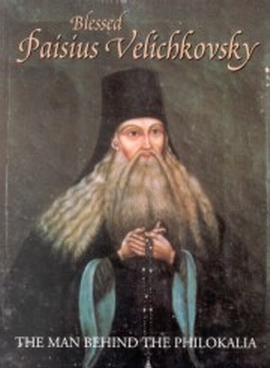
 | December 22, 1972, marked the 250th century there is no more important Holy Father of recent times than Blessed Paisius Velichkovsky. This is so not merely because of his holy life; not merely because , like another Saint Gregory Palamas, he defended the hesychast practice of the mental Prayer of Jesus; not only because he, through his many disciples, inspired the great monastic revival of the 19th century which flowered most notably in |
the holy Elders of Optina Monastery, but most of all because he redirected
the attention of Orthodox Christians to the sources of Holy Orthodoxy,
which are the only foundation of true Orthodox life and thought whether of the
past r of the present, whether of monks or of laymen.
It is
these very same sources – the Divine Scriptures and the writings of the Holy
Fathers – which are the foundation of all genuine Orthodoxy in our own times.
The observer of the Orthodox world today can see easily enough what “Orthodoxy”
becomes when these sources are not made the foundation of life and thought.
The
followers of unenlightened custom are themselves innocent; they merely accept
what has been “handed down” to them. But not seeing the meaning and not
knowing the sources of what has been handed down, they are easily led
into error, accepting customs which the Church has allowed only out of her
condescension or economy as if they were the best of Orthodoxy, and also
improper customs of recent heterodox origin and inspiration, together with the
pure and meaningful Orthodox customs handed down from the Holy Fathers. Under
strict yet prudent pastors, such people can be guided in the true path of
Orthodoxy; but in our won time of such widespread irresponsible Church
leadership, these people are more often guided gradually into a path of ever
greater and more senseless innovation and reform, the clearest example of which
is perhaps the Greek Archdiocese of America, where pews, organs, and Uniat
spirituality and theology have become the new “customs” of an unfortunate
people whose Orthodoxy has been stolen from it.
Far
worse, however, is the state of those who, being unrooted in the true sources
of Holy Orthodoxy, occupy the positions of pastors and theologians and in their
“learned ignorance” seek to guide their flocks according to some fashionable
intellectual current of the day. Such are the leaders of the “ charismatic
movement,” swept off their feet by an experience which, while compatible with
Protestantism and Papism, is easily discerned as a satanic deception by those
who are rooted in and live in the Holy Fathers. Such also are the “theologians”
of the “Paris” and other modernist schools who, being at home in heterodox
modes of thought and life, dare to present the Holy Fathers themselves
according to the disfigured modern understanding of them, transmitting neither
their true message nor (much less) their Orthodox savor, giving rather an
academic two-dimensional caricature of them, suitable only for presentation in
decadent ecumenical salons and in lifeless academic journals.
Both of
these types of “Orthodox” people are precisely those who are cut off from
the sources of Orthodoxy, and who in turn help to cut others off from these
sources. The movement of true Orthodoxy in our won times has seen with
increasing clarity the need to separate itself form this pseudo- or
semi-Orthodoxy and refind its roots in the true and unadulterated sources of
Orthodoxy, the Holy Fathers. And this is precisely what the Blessed Paisius saw
and did, making him a key figure for us today.
Having
come to love the Holy Fathers and true Orthodox piety in his childhood, Blessed
Paisius at the age of 17 saw that even in the best Orthodox school of Russia he
was not being given the pure teaching of Holy Orthodoxy from the patristic
sources, but rather something second-hand and accompanied by useless pagan
learning; and, further, that an other-emphasis on the formal side of the
Church's existence, greatly furthered by the Government in tis attempt to make
the Church a “department” of the State, promoted chiefly the idea that
church-minded people, the clergy and even the monks, occupied a definite place
in the apparatus of the Church organization. This overemphasis of a real
but decidedly secondary aspect of church life tended to obscure the primary
aspect: the love and zeal fro true Orthodoxy and true piety, which are what
inspire every genuine Orthodox Christian, whether clergy, monk or layman.
Seeing the difficulty of exercising his love and zeal in the
Today the
situation of Orthodoxy is rather different, and much worse, than it was in the
time of the Elder Paisius. IN place of the veneer of paganism and Latinism
which never actually touched the heart of Orthodoxy, we have today a prevailing
atmosphere of modernist heterodoxy and senseless “keeping up with the times” which
has pierced the very heart of some Orthodox Churches so deeply that they will
doubtless never recover, and their children are deprived of Orthodoxy without
even knowing what they have lost. In place of the heavy hand of governmental
bureaucracy, we see the far heavier hand of pseudo-Christian and pagan ways of
live which are depriving Orthodox Christians of something which was almost
untouched in the time of Blessed Paisius: Orthodox piety, the whole Christian
way of life. And, to make this whole difficult situation virtually impossible,
we are beset with self-styled reformers and revivers who neither know nor feel
nor love what Orthodoxy is and would “restore” the faithful to the latest
fashion of Protestant scholarship or piety. The 17-year-old Orthodox youth of
today has usually not been raised properly and consciously in Orthodox teaching
and piety, or, if he has, the ever-increasing tempo of paganized modern life
acts powerfully to negate his upbringing; he has usually not come to love the
Holy Fathers and the Divine services from childhood, and to hunger for more;
and there is scarcely anywhere he can turn in order to correct the deficiencies
of his upbringing and environment: of all the Orthodox seminaries in he free
world, it is doubtful that any save the Russian-language seminary at Holy
Trinity Monastery (Jordanville, New York) will even attempt to give him an
education in genuine Orthodoxy. For such a youth not deeply grounded in
Orthodoxy the human side of the Church all too often becomes the center of
attention, and the all too prevalent petty quarrels and injustices among church
people are often sufficient to turn his attention away from the Church
altogether, or – if some religious interest remains – to turn him toward one of
the flourishing religious or social cults of the day, or even to the
widely-advertised life of drugs and immorality.
Truly, we
are far more in need today of a return to the sources of genuine Orthodoxy than
Blessed Paisius was! Our situation is hopeless! And yet God's mercy does not
leave us, and even today one may say that there is a movement of genuine
Orthodoxy which consciously rejects the indifference, renovationism, and
outright apostasy which are preached by the world-famous Orthodox “theologians”
and “hierarchs” and also hungers for more than the “customary” Orthodoxy which
is powerless before the onslaughts of a world refined in destroying souls. It
is of course true that the world, saturated in Holy Orthodoxy, which produced
Blessed Paisius no longer exists; and it is likewise true that the numbers of
God-bearing elders whom Paisius met and produced on his path, even in an age of
spiritual decline, are simply unheard of in our own days, which are surely the
days of the last Christians. And yet it cannot be that the flame of truly
Orthodox zeal will die out before the Second Coming of Christ; nor that if this
flame exists, Christ our God will not show His zealots, even now, how to lead a
true and inspired Orthodox life. In fact, the message of Blessed Paisius is addressed
precisely and directly to us, the last Christians: in “The Scroll” he tells us
that the Holy Fathers wrote their books “by the special Providence of God, so
that in the last times this Divine work would not fall into oblivion.”
Do you
hear, O Orthodox Christians of these last times? These writings of the Holy
Fathers, even those dealing with the highest form of spiritual life, have been
preserved for us, so that even when it might seem that there are no
God-bearing elders left at all, we may still have the unerring words of the
Holy Fathers to guide us in leading a God-pleasing and zealous life. Therefore,
they are wrong who teach us that, because the end of the world is at hand, we
must sit still, make no great efforts, simply preserve the doctrine that has
been handed down to us, and hand it back, like the buried talent of the
worthless servant (Matt. 25:24-30), to our Lord at His coming. Blessed Paisius
teaches that “solely by Orthodoxy of faith, without the diligent keeping of all
Christ's commandments [i.e., putting Orthodoxy into practice, with great
effort], it is not at all possible to be saved.” The time of the end,
though it seems to be near, we do not know; however close, it is still future,
and in the present we have only the same age-old fight against the unseen
powers, against the world, and against our own passions, upon the outcome of
which our eternal fate will be decided. Let us then struggle while it is still
day, with the time and the weapons which our All-merciful God has given us!
The Life
of Blessed Paisius is of special value to us because it is the Life of a Holy
Father of modern times, one who lived like the ancients almost in our own day.
All those deadly anti-spiritual currents which threaten now to enslave man
completely – godless humanism, soulless ecumenism, and the fierce Revolution
that has brought them to power upon ruins of civilization in a sea of blood –
either existed already or were born in his lifetime. The spiritual climate of
his times was very similar to our own; many of our own temptations were also; a
number of our most pressing questions he answered for us. This virtual
contemporary of ours struggled and was gloriously crowned, and God, seeing his
labors, gave to him a hundredfold of spiritual fruits which are nourishing
Orthodox Christians even to this day, and revealed in him the fount in modern
times of the pure tradition of Russian Orthodoxy.
The
reader of this Life must be cautioned, however, against reading it too
“enthusiastically”. Bishop Ignatius Brianchaninov, the great 19th-century Holy
Father who perhaps better than anyone else expressed the meaning of Blessed
Paisius' life's work, warns us that “novices can never adapt books to their own
condition, but are invariably drawn by the tendency of the book... If a book
speaks of unconditional obedience under the direction of a Spirit-bearing
Father, the beginner will inevitably develop a desire for the strictest life in
complete submission to an Elder. God has not given to our times this way of
life. But the books of the Holy Fathers describing it can influence a beginner
so strongly that out of inexperience and ignorance he can easily decide to
leave the plce where he is living and where he has every convenience to work
out his salvation and make spiritual progress... for an impossible dream of a
perfect life pictured vividly and alluringly in his imagination” ( The Arena,
ch. 10).
The life
of Blessed Paisius is not meant to exalt the beginner ( and we all, in our
spiritually feeble 20th century, are “beginners”) and make him think
that he is capable of such a life; not at all. Elder Macarius of Optina,
another 19th-century continuer of the work of Blessed Paisius,
teaches that “the holy God-bearing Fathers wrote about great spiritual gifts
not so that anyone might strive indiscriminately to receive them, but so that
those who do not have them, hearing about such exalted gifts and revelations
which were received by those who were worthy, might acknowledge their own
profound infirmity and great insufficiency, and might involuntarily be inclined
to humility, which is more necessary for those seeking salvation than all other
works and virtues” (Letters to Monks, Moscow, 1862, p. 370). Four
centuries earlier St. Nilus of Sora wrote, concerning the lives of holy men:
“We who are burdened with many sins and preyed upon by passions are unworthy
even of hearing such words. Nevertheless, placing our hope in the grace of God,
we are encouraged to keep the words of the holy writings in our minds, so that
we may at least grow in awareness of the degradation in which we wallow” (Monastic
Rule, ch. 2). And even in the 6th century, St John of the Ladder
wrote: “Just as a pauper, seeing the royal treasure, all the more acknowledges
his own poverty, so also the spirit, reading the accounts of the great deeds of
the Holy Fathers, involuntarily is all the more humbled in its way of thought”
(The Ladder, Step 26:25).
These are
the words of the Holy Fathers of past centuries, when Orthodoxy was firmly
rooted in the human soul and had transformed whole societies. How much more
necessary is the humility they speak about in our spiritually uprooted
superficial 20th century!
We must,
of course, continue to read Orthodox spiritual texts, such as the Life of
Blessed Paisius, or we will spiritually whither and die. But we must at the
same time humble ourselves and use the very height of the life descirbed in
these texts as our opportunity to “grow in awareness of our degradation,” as
St. Nilus so well says. We must properly apply the Life of Elder Paisius to our
own spiritual condition.
Therefore,
let all readers be aware:
1. There
are no more elders like Paisius today. If we imagine there are, we can do
irreparable harm to our souls - “imagination” being precisely one of the forms
of prelest or spiritual deception. We must learn to read of his life and
deeds without being able to apply them entirely to our corrupt and degraded
life. At the same time, we must have respect for our spiritual fathers and
elders, who at least know more than we and try their best to guide their
spiritual children under almost impossible conditions. Many young people today
are seeking gurus and are ready to enslave themselves to any likely
candidate; but woe to those who take advantage of this climate of the times to
proclaim themselves “God-bearing Elders” in the ancient tradition – they only
deceive themselves and others. Any Orthodox spiritual father will frankly tell
his children that the minimum of eldership today is very different from what
Blessed Paisius or the Optina Elders represent.
2. The
type of community which Paisius guided is beyond the capability of our times.
Bishop Ignatius said that such a way of life was not given even to his times –
when Optina was at its height; and how much more has Orthodox life fallen since
then! Such a “heaven on earth” could not exist today, not just because there
are no God-bearing Elders to guide it, but because even if there were, the
spiritual level of those who would follow is too impossibly low. Ours is the
age of apiritual fakery par excellence, not of the ancient Spirit-bearing life.
The Abbot of any Orthodox monastery today will tell you the same.
But let
us therefore learn to make maximum use of limited opportunities we do have
(which still, after all, are “heaven on earth” if compared to the worldly life
of today!), not demolishing our few remaining Orthodox communities with
self-centered and idle criticism, nor unsettling ourselves and others by dreams
of impossibly perfect communities.
3. Our
times, above all, call for humble and quiet labors, with love and
sympathy for other strugglers on the path of Orthodox spiritual life and a deep
resolve that does not become discouraged because the atmosphere is unfavorable.
We Christians of the latter times are still called to work persistently on
ourselves, to be obedient to spiritual fathers and authorities, to lead an
orderly life with at least a minimum of spiritual discipline and with regular
reading of the Orthodox spiritual literature which Blessed Paisius was chiefly
responsible for handing down to our times, to watch over our own sins and
failings and not judge others. If we do this, even in our terrible times, we
may have hope – in God's mercy – of the salvation of our souls. Perhaps the
chief function of the Life of Blessed Paisius for us today is to give us the
courage to endure the frightful anti-spiritual climate of our times; for as our
Saviour warned us, even in the last times when “the love of the many shall grow
cold,” he that endureth to the end shall be saved (Matt. 24:13).
The Life
of Elder Paisius which we here present was written by his own disciples,
chiefly by Schema-monk Metrophanes of Niamets Monastery, and was published in
its present form exactly 15 years ago (1847) by the God-bearing Elders of
Optina Monastery as the first of the texts of the veritable patristic revival
which they inspired in 19th-century Russia. It is much to be
preferred to the 20th-century biography (The Moldavian Elder,
Schema-Archimandrite Paisius Velichkovsky by Archpriest Sergy Chetverikov)
in that it gives not only the facts of the Elder's life, but more
importantly, the very savor of his struggles. It is itself a patristic
text capable of guiding and inspiring the Orthodox believer today.
- Monk
Seraphim Rose
